Why I built FirearmLog
Start from where you are
I came to shooting late, and I came to it knowing nothing.
I bled from slide bite and figured that was the cost of admission. I learned to load a magazine off YouTube. It genuinely did not occur to me that you were supposed to clean a gun. If there was a beginner's mistake to make, I made it — usually twice.
But I'd been an athlete, and being an athlete taught me two things before I ever picked up a pistol: good coaching shortcuts the learning curve, and practice locks it in. So I didn't try to wing it. I took lessons.
Standing still, taking my time, I could hit what I aimed at. I figured I was pretty good.
Then a class added the things that actually count — a shot timer, a little movement, a little pressure.
“I couldn't hit a horse standing in my own kitchen.”
The moment any of that was in play, I came apart. I had badly overestimated where I was. And I realized that if I actually wanted to get better, I had to stop guessing about my progress and start measuring it.
Maybe you've felt that too — put in the work, and still not been able to say, honestly, whether you're getting better. If so, you and I are already on the same page, and the rest of this is what I did about it.
What, why, when, and who
The trouble was, I didn't really know what to measure.
I knew the what, sort of — am I shooting accurate groups at 5, 7, 10 yards? How are my transitions? But the what was the easy part. The questions that actually made me better were harder. Why am I pulling low-left when I push for time? (I was tightening my grip hand as I broke the shot.) Why are my groups stringing low? (Pushing — anticipating the recoil.) Why do my shots bounce all over on transitions? (Staring at the dot instead of driving my eyes to the next target.)
Then the two I'd never have thought to write down. When — and the honest answer was whenever I felt like it. I was at the range three or four days a week, which sounds disciplined until you realize I never once drove there thinking “this week is trigger control” or “today is cadence drills.” For the first several months I was just turning money into noise. A lot of reps, no purpose behind any of them.
And who — because I didn't get anywhere alone, and the people who got me unstuck were specific. Ben Stoeger, through his videos, taught me to occlude my dot so I couldn't stay dot-focused, and that target focus, not dot focus, is the whole game. One coach caught me tightening my grip on every press and got me to quit it. The coach I worked with most taught me to transition with my eyes first and the gun second. These were people teaching me the craft. (Part of the learning was telling the coaches teaching me the craft from the ones who mostly wanted an audience — and giving my time to the first kind.)
That's when it landed: the things that mattered most — the why, the when, the who — were exactly the things none of my notes ever captured.
The day I got caught
The first time I knew I had to keep track, that coach asked me how much I was dry-firing. “All the time,” I said — and I believed it.
Two weeks later he asked again. But now I was paying attention, and the truth was less flattering. Some days I dry-fired for a real hour, working my grip, building a stance. And some days — more than I'd have admitted out loud — I sat at my desk and lazily pointed my gun at the doorknob and pressed the trigger and called it training.
That second question is the reason this app exists. I knew I needed to practice in a deliberate, routine way, and that meant writing it down. So I did.
Then the log just kept growing
What I didn't expect was that every time the sport taught me something the hard way, my little log grew a new part.
The ears. I had an indoor lesson with that same coach. That morning I was running late — I'd been teaching my dog Chelsea to walk on her hind legs — and I forgot my ear plugs. I wore what I'd charitably call high-school-sophomore electronic muffs and normally doubled up with plugs underneath; I'd hurt my ears diving in college, so I start from behind. I walked out of that session feeling like I'd spent an hour inside a bell tower. (Another time I left my holster at home and ran a four-hour class out of the wrong rig entirely.) So: I needed a gear checklist.
The optic. The SRO on my Apollo died mid-session and I had no idea what distance it had even been zero'd at. Trijicon turned a new one around fast — but I zero'd it at 10 yards, and my Erebus was zero'd at 25, which is its own kind of exciting. (All my handguns are zero'd at 15 now.) So: log the optics.
The ammo. I shoot Blazer Brass, 115 or 124 — never a hiccup. Then I bought a thousand rounds of a different brand and had three failures to eject in short order. So: track the ammo and malfunctions.
The magazines. I got tired of reloading at the range, so I bought eight magazines — and, because YouTube informed me that magazine springs wear out, and that the magazines themselves want the occasional cleaning (who knew), ten spare springs to go with them. Eight months later the app I was then using told me it was time to replace those springs, so I ordered ten more, set them in the closet with the rest of the gun stuff to swap over the weekend, and on Saturday found twenty springs sitting in a bag right next to each other. So: track the inventory.
I tried the apps that already existed, of course, but none of them tracked everything I wanted to know. So I stopped waiting for the right one and built it — with the log on your own device, and one tap that writes the whole thing out to a file you keep. Nothing of yours to lose to somebody else's bad update.
Chelsea
Chelsea is a Goldendoodle and my more-or-less constant companion — in my office while I work, in the car, and on our three walks a day (we put up about 15,000 steps when it isn't too hot). She's been to the range, but not often. Honestly, the time I'm shooting is about the only time she isn't with me.
Start from where you are
I'm early in my first season — training every week, working toward my first USPSA classification. I don't know how far I'll get.
I've always believed you start from where you are. You can't get better yesterday; you can only start from here. If you're new, get better. If you're good, improve. If you're great, keep climbing. Two percent better than last time, every time. One day of that is almost nothing — a year of it is everything.
FirearmLog is how I prove I'm moving. I built it for me — but if you're anywhere on that same climb, I built it for you, too.
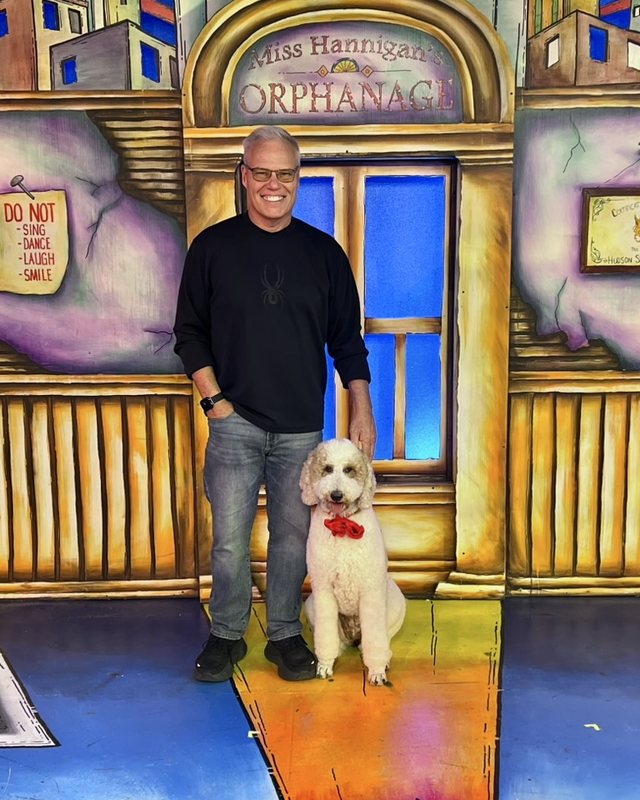
Michael Minik, with Chelsea — founder, and the app's first and most demanding user.
— Michael Minik
You're on the list — I'll email you when the apps launch.
Sorry — that didn't go through. Please try again.
One email when the apps launch, plus the occasional update worth your time. No spam, unsubscribe anytime. Privacy.